They lingered, still and silent, Scarlet straining to listen for what had Wolf on edge. Slowly reaching behind her, she pulled the gun from her waistband. The click as she released the safety echoed off the trees.
Off in the woods, a wolf howled. The lonely cry sent a shiver down Scarlet's spine.
Wolf didn't seem surprised.
Then, behind them, another howl, this one farther away. Then another to the north.
Silence crept around them as the howls faded longingly into the air.
"Friends of yours?" Scarlet asked.
Clarity returned to Wolf's expression and he glanced at her, then down at the gun. It struck her as odd that he could be startled by it, when the howls had garnered no reaction at all.
"They won't bother us," he said finally, turning and heading down the tracks.
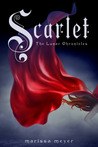
Author: Marissa Meyer
From Goodreads: The fates of Cinder and Scarlet collide as a Lunar threat spreads across the Earth...
Cinder, the cyborg mechanic, returns in the second thrilling installment of the bestselling Lunar Chronicles. She's trying to break out of prison—even though if she succeeds, she'll be the Commonwealth's most wanted fugitive.
Halfway around the world, Scarlet Benoit's grandmother is missing. It turns out there are many things Scarlet doesn't know about her grandmother or the grave danger she has lived in her whole life. When Scarlet encounters Wolf, a street fighter who may have information as to her grandmother's whereabouts, she is loath to trust this stranger, but is inexplicably drawn to him, and he to her. As Scarlet and Wolf unravel one mystery, they encounter another when they meet Cinder. Now, all of them must stay one step ahead of the vicious Lunar Queen Levana, who will do anything for the handsome Prince Kai to become her husband, her king, her prisoner.
Notes: Having spent comparatively little time with manga and anime, neither came to mind while I read Cinder. Knowing that Meyer credits the genres—particularly the crossover story Sailor Moon—as influences, however, made Scarlet an easier read and gave me a better understanding of the series as a whole. The juxtaposition of fairy tale and science fiction is too splendid to cause me any difficulties, but odd little details ranging from the erratic naming patterns to the sudden, shocking bursts of violence hadn't made sense to me outside the anime genre.
Inside, they fit right in. I haven't read Sailor Moon, but my hours with the Elric brothers (Fullmetal Alchemist) set me up well enough for accepting out-of-place names (on account of which, I assume I don't have to pronounce 'Scarlet' as 'Scar-leh', à la français). Likewise, the anime prepared me for the fact that teenage Scarlet is as casual about picking up a gun and shooting a human being as teenage Cinder is, despite neither of them apparently having had previous experience.
I can't say just how typical this is for anime, but Fullmetal Alchemist contained a lot of gut-kicking horror, and Scarlet had its moments as well. Scarlet is significantly darker than Cinder, in much the way that its base fairy tale—Little Red Riding Hood—is darker than Cinderella (except for maybe versions like the Grimms', where the stepsisters cut off parts of their own feet to get into the slipper). Marissa Meyer's werewolves are more Fenrir Greyback than Jacob Black: not simply frightening, but flat-out abhorrent.
That said, her werewolves, while not unique as a sci-fi human/monster trope, were kind of a neat spin on the much-done teenage werewolf meme. This is true both in terms of monster creation and monster romance. The attempts at Wolf's redemption also reminded me of one of the small handful of things I loved about Mockingjay, without coming off as a copycat treatment.
As fairy tale, the story is well handled; Cinder's character arc continues while her place in the traditional tale is on pause, and the take on Red Riding Hood was fascinating and sometimes a little bit lovely around the grotesque and horrible. I found myself reminded rather forcibly of Phantom of the Opera a few times, too.
The book isn't faultless. Cinder and Scarlet are both basically angry, independent, work-focused, gun-toting sixteen-year-old girls, with not much to differentiate them outside the obvious physical variances—which is odd, because Wolf and Kai manage to be perfectly well differentiated despite certain strong similarities. Meyer's France is no more culturally interesting than her New Beijing, and her prose is often sketchy. I can overlook a lot for the sake of good characters, however, and if I could barely tell Cinder and Scarlet apart, at least they didn't bore me. And I'd be remiss if I didn't praise Iko and Thorne, who both turned out to be quite entertaining.
Considering that I couldn't wait two weeks to read the sequel to Cinder, I suspect it's going to be a long year waiting for the sequel to Scarlet.
Even wizards must occasionally deal with droll, nitty gritty business details, such as the question of writing decent sentences, and Christie, in her introductory post, made a point that made me shoot jubilant sparks at the ceiling out of sheer exuberance and shout, "YES, thank you":
As someone trained in literature and an amateur writer myself, I noticed things like simple diction, trite turns of phrase, and tendency to rely on adverbs. But I've never been a fan of the high-brow literary school of critics—why can't plain but clear writing, as much as beauteous writing, be an effective stylistic choice?—and when I try to imagine HP written in a florid post-modern voice, it loses an essential quality I can't quite put my finger on.
This writer thinks it highly unlikely that famous Harry Potter (I should really stop quoting Malfoy) would have been nearly so famous if he had been written by a stylist of literary aspirations, particularly one aiming at hooking adult readers along with the youngsters. There's nothing wrong with simple writing; it's a good way to reach young audiences, and it's the only way to reach a broad audience.
Christie also had great things to say about Dumbledore and Muggles and Christmas—heartily recommended. Meanwhile, Masha, having been cheated (by me) out of the chance to be the first to argue with Michael O'Brien (if calling him "a naughty dragon-hating Muggle" counts as arguing), set her sights on John Granger instead:
None of us have the wish or temperament to argue against [magic or dragons]; but that doesn’t mean I won’t be bringing up the problematic aspects of Harry’s magic (there are plenty), and I think a good long discussion of this whole ‘incantational vs. Invocational’ [Granger's] argument has to happen at some point as well, which will be fascinating! Well be talking about the character of the characters, about Rowling's worldview, about the role of men as fathers in the books... Do [the books] inspire readers to see the world in rich possibilities or do they tie readers down to a secular-relativistic worldview in which evil is decidedly banal and suburban and good is its very near twin??
...as well as reminding us that "even if all the books bother you, it’s ok to be delighted by sections, just as it’s ok to be appalled by some things, even if you love the series overall. No author gets it all right!" I wholeheartedly concur.
And now, onto this coming week!
* * *
Read: Harry Potter and the Sorcerer's Stone, chapters 2-4
Photo from Shelagh's page, as linked above.
Looks good, Shelagh!
Recipe:(Shelagh's) Knickerbocker Glory. Magic or Muggle, you'll need a whole mouthful of sweet teeth to down this tall-glass concoction, made with fruit, ice cream, fruit syrup, whipped cream, wafers, glazed cherries, and in some variations, even jelly. I'm not sure I could handle jelly, myself... even strawberry ice cream is a bit much for me... but it definitely looks like an exciting parfait.
I'm not sure I'd want to eat after Dudley, though. Cooties!
Potential Discussion Points (but by no means all the potential):
1. Harry has his first communication with a snake in Chapter Two: The Vanishing Glass. From henceforth, snake imagery in the series will—as I recall—be a very traditional, Book-of-Genesis kind of thing. Here, however, a lonely ten-year-old shares a friendly moment with another caged, controlled creature, and manages to unwittingly offer the boa constrictor a bit of helpful magic.
One of the recurring motifs in the books, and here I do owe this point to Prof. Granger, is the idea of doppelgangers—twins, mirror images, shades; pairs set up for striking similarity and/or contrast. They pop up everywhere, and Dudley is arguably Harry's first (of many), but this bored snake is a very early, very striking one. Harry sets the snake free from its confinement and mistreatment much as Hagrid sets Harry free from his. And the connection between Harry and the boa, innocent in itself, foreshadows a darker doppelganger, some sinister facts that aren't quite revealed until the last two books.
2. Voldemort. If I type 'flight of death' into Google Translate and get it turned into French*, the result is vol de la mort. Apropos, no? Of course, we're already being introduced to the fact that the Wizarding World is afraid even to speak that name. I can sympathize. I'm not fond of saying 'Satan' either—one doesn't want to draw diabolic attention, after all. But "You-Know-Who" and "He-Who-Must-Not-Be-Named" are admittedly kind of awkward and evasive, and when great big men like Hagrid jerk and wriggle at the very sound of the syllables, things have gone a bit far.
3. Both Petunia and Vernon Dursley give short, spiteful little rants upon being confronted by Hagrid, to much the same effect, if in their own voices. You're a freak from a family of weirdos, Harry, and we swore we'd stamp out all that dangerous nonsense. It's interesting to see the subtle differences between how Petunia handles things—or would handle them, if she were in charge—and how Vernon does, however. Petunia grew up with a witch; she knows when not to run. All Vernon knows is control, and he goes dangerously near crazy when he begins losing grip on his own idealized normalcy.
4. "Yeh've got your mom's eyes." It's the first time Harry hears these words. And since we're going cautious with spoilers, all I'll say for now is that it won't be the last.
I love The Keeper of the Keys—it's a favorite chapter of mine; with Hagrid, his pockets full of sausages and dormice, and with Harry's unexpected first experience of having someone call him by his name with affection—
"An' here's Harry!" said the giant.
Harry looked up into the fierce, wild, shadowy face and saw that the beetle eyes were crinkled in a smile.
—it's the reader's earliest introduction to the Wizarding World through the protagonist's eyes. And Hagrid is such a big lovable cornball fellow, with magic clinging to him like the raindrops on his coat even though he's not technically supposed to do any... I don't care what you call the prose. This chapter is just delightful.
* * *
About spoiler warnings: Please include them in discussion posts if you're about to cover a later plot development, for the sake of Christie and others who haven't read the series from the front cover of SS to the back cover of DH yet.
Ready to discuss? Hop in!
* The spell for translating vernacular to French should be, I think, "Pretatio Franci!" Since I had to use Google Translate to get the Latin instead of actually consulting my resident Latinist(he's at work), however, use carefully or you might suddenly find yourself unable to speak anything but French. Or something equally unhelpful. I don't think you'll find yourself on the floor with a buffalo on your chest, but you never know.
It's hard not to be in a good mood today. The forecast has seventies in it for over the weekend, and the apple tree is in bloom!
as are the bluebells... and the pink bells, and the white bells:
and the Solomon's seal:
and the white lilac and the red rhododendron:
and the columbine:
and the roses are getting close:
and the sumac, after months of being an unassuming fuzzy stick, is leafing out. I love this baby tree.
Also, I love all the garden's little secrets. I've been having fun putting some of them in myself. Under the garden hoops live the tomatoes:
(and behind the garden hoops lives a ridiculously large brush pile)
and behind the rosemary, the sweet peas are beginning to climb their little trellises:
All the sunshine has me feeling positively cheery. If, as suggested, it gets to seventy-eight on Sunday—that's shorts weather, or wear-my-sundress-all-day weather. It's gin-and-tonic, read-out-on-a-blanket-in-the-sun, hook-up-the-hose-for-the-first-time-this-year-and-water-the-gardens weather. My kind of weather.
Maybe I'll take Harry Potter out on a blanket and get some reading in.
* * *
Maia in "There's something interesting on the floor, and I think I'm going to kill it" mode:
From here, it looks like a bit of already-dead koosh ball,
left over from nieces' visit.
* * *
Music of the week: The Flower Duet from Delibes' Lakmé. The speakers max out into crackles a few times in this recording, but I've no fault to find with the singing.
Clearing her throat, Cinder refocused on the android. She found the nearly invisible latch and opened its back panel. "Why aren't the royal mechanics fixing her?"
"They tried but couldn't figure it out. Someone suggested I bring her to you." He set the foot down and turned his attention to the shelves of old and battered parts--parts for androids, hovers, netscreens, portscreens. Parts for cyborgs. "They say you're the best mechanic in New Beijing. I was expecting an old man."
"Do they?" she murmured.
He wasn't the first to voice surprise. Most of her customers couldn't fathom how a teenage girl could be the best mechanic in the city, and she never broadcast the reason for her talent. The fewer people who knew she was cyborg, the better. She was sure she'd go mad if all the market shopkeepers looked at her with the same disdain as Chang Sacha did.
Author: Marissa Meyer
From Goodreads: Humans and androids crowd the raucous streets of New Beijing. A deadly plague ravages the population. From space, a ruthless lunar people watch, waiting to make their move. No one knows that Earth’s fate hinges on one girl. . . .
Cinder, a gifted mechanic, is a cyborg. She’s a second-class citizen with a mysterious past, reviled by her stepmother and blamed for her stepsister’s illness. But when her life becomes intertwined with the handsome Prince Kai’s, she suddenly finds herself at the center of an intergalactic struggle, and a forbidden attraction. Caught between duty and freedom, loyalty and betrayal, she must uncover secrets about her past in order to protect her world’s future.
Notes: To be honest—perhaps too honest—my first thought upon reading the first page of Marissa Meyer's popular sci-fi/fairy tale was immense relief. It seems so long since I found a recently-published young adult novel written in third person and past tense. Thank heaven, the comfortable old narrative modes still hold some life and popularity.
Cinder is set in futuristic New Beijing, the details of which interested me much more than Meyer managed to provide for. I wanted to feel China, to track with the thought patterns of an Eastern culture and get some sensory intake from the city. Little of this was offered. I never did figure out how universally I was supposed to picture the setting and people as Chinese. The names are too mixed in influence to even guess; there are few physical cues to aid the reader, and next to no cultural ones.
That said, what Meyer did rather well was imagine life as a cyborg. Linh Cinder—surname first, China-style—doesn't remember life before the fusing of her badly damaged body to a futuristic set of mechanical parts: a robotic foot and hand, a control panel connected to her brain, a lot of internal wiring. Her experience is relatably human, with the additives of a computer feed into her thoughts and eyesight and an understandable teenage fear of being not human enough. While I occasionally found her choices less than believable—for all the fluttery interest she shows in Prince Kai, she is terrifically lackadaisical about fixing his android—she was very readable and sympathetic.
The juxtaposition of science fiction and fairy tale was fantastic. It's hard to point out and praise specific details without giving spoilers, but Meyer threw a deadly plague, an aggressive lunar colony, and cybernetic technology into the Cinderella story—cliffhangering it at the end to make room for three more fairy tales to come—and, in reverse, succeeded in imposing magic into sci-fi as well, which is hard to do believably.
Cinder's real identity came as no surprise to me, but the ending did. It had some nice finesse to it, but it made me want to yell. I railed at the abruptness for about a day, and then I went and tracked down the sequel, Scarlet, which I intend to read shortly. Of course, the way of the serial suggests I'll be waiting a couple of years and two more books before the last big element of Cinderella's story comes into play.
Ladies and gentlemen, wizards and Muggles alike, my co-hostesses and I gladly welcome you to a thoughtful, playful, highly interactive read-through of all seven Harry Potter books, start to finish. We welcome you as fellow bloggers who want to write your own posts; we welcome you as fellow readers who are interested in following along and maybe commenting from time to time; we welcome you no matter what your experience with the Wizarding World has been, or whether it has been any experience at all.
This is not just any thoughtful, playful, highly interactive read-through, either. It's an extensive conversation between three disparately-experienced readers: one longtime Potter fan, one longtime not-a-Potter-fan, and one new reader of the stories. Ideally, it will be intense—and magical—and legendary—and fun.
Details follow, but first, allow me to introduce your hostesses:
Masha
Blog: Cyganeria
Favorite authors: Lev Tolstoy, Ernest Hemingway, Rainer Maria Rilke, J.R.R. Tolkien
Magical imagination: Superstitious, elemental
Relationship to Harry Potter: Read all the books and didn't like them
Christie
Blog: Spinning Straw into Gold
Favorite authors: J.R.R. Tolkien, C.S. Lewis, G.K. Chesterton, Flannery O'Connor
Magical imagination: Traditional, unpredictable/mysterious, fairy-taleish
Relationship to Harry Potter: Has only read the first book
Jenna
Blog: A Light Inside (you're reading it right now, in case that wasn't clear)
Favorite authors: Jane Austen, Orson Scott Card, C.S. Lewis, Shannon Hale
Magical imagination: Bright, paradoxical, transcendent
Relationship to Harry Potter: Wizard-rocking, Blogengamot-hat-wearing, trivia-spouting Potterhead
That's us! I should note that we are all Catholic, so faith will come up from time to time. Religion is not a requirement for the festivities, however, and we certainly hope you'll be able to enjoy yourself no matter where you're coming from thought-wise. I should also note that I made up all the dossiers myself, so, Masha and Christie, hopefully I didn't get your factoids wrong. xD
Now, for some basic details on the schedule and events:
Pacing will be informal. We begin with Chapter 1 of Philosopher's/Sorcerer's Stone, and from thence will work thematically. I will post upcoming reading in sections by week or bi-week, though we may linger over sections that merit extended discussion. No, we have no idea when this will end.
Participation is encouraged in a variety of forms. I will include linkups for bloggers who would like to post responses on their own blogs; the first will be at the bottom of this post. Comments are more than welcome, always, provided they are not left by trolls. (We stick wands up trolls' noses and hit them over the head with clubs—beware!) And, of course, we hope you'll read along.
Friends of friends are welcome, too, and friends of friends of friends, and curious onlookers, and gate-crashers, though again, trolls will naturally be moderated out of the conversation. ;)
And we don't intend to just talk. There will be recipes. There will be music. There will be pictures. There will be nitwits and oddments and blubber and tweaks! Stick around. And now...
Exordio!*
How does one go about introducing famous Harry Potter, whom so many of you already know? And about whom so much has been said, written, presumed, cogitated, formulated, debated, and analyzed? Harry has inspired thousands of essays, songs, fan sites, a large number of books, at least one activist organization, and conversations beyond number. Little kids in third-world countries read Harry in his day. Prisoners on Death Row read Harry in his day. And apparently the British Royals have read their Harry, too:
William and Kate practicing for the D.A.
I bet they've actually met Kingsley Shacklebolt. Jealous. Source.
This despite the fact that it at least begins as a children's story—which is very obvious in book one, and Rowling grew the story up in later books without significantly raising her style. But C.S. Lewis said, "I am almost inclined to set it up as a canon that a children's story which is enjoyed only by children is a bad children's story. The good ones last," and Rowling apparently agrees. She gave adults plenty to play with: puzzles, games, alchemical symbolism, wordplay, mythology, humor, irony, politics, a detailed world to explore, and a tale that is all but overtly Christian and sacramental, if you know what you're looking for, though it's not so overt that it reads as exclusive to non-Christians or to those whose faith more or less rejects sacramentalism.
And now, since we're Catholic and this comes up: To the very best of my knowledge, the Catholic Church's position on the Potter books is open. You can freely read them or not read them. There have been no official warnings that I am aware of, with official meaning "coming from someone with the authority to make such a call for the Church at large," e.g., a council of bishops. Fr. Amorth's opinions are just opinions. Diplomatic letters from then-Cardinal Ratzinger to the author of an anti-Potter monograph are just diplomatic letters. L'Osservatore Romano is presumably impartial as it has, I believe, run articles on both sides of the debate. Michael O'Brien is a naughty dragon-hating Muggle who ought to go work for Charlie Weasley for a while. Harry Potter numbers plenty of Catholic priests among his fans—try the Secrets of Harry Potter podcast, created and originally hosted by Fr. Roderick Vonhögen, if you're curious—and plenty of popular Catholic bloggers, too; here, since my own name isn't big enough to drop and make any noise, I'll name-drop Mark Shea. You can be a good Catholic and a good Harry Potter fan. It's legit.
Dealing with the Bible directly is waaaayyyy too complicated for this segment, but if I believed that the Bible and Harry Potter were in any real conflict, I wouldn't be championing the latter all over the planet. The books are carefully distanced from common modern superstitions and are absolutely free from invocational sorcery and spiritism. The wizardry in Harry Potter is sort of a parody of a fictive exaggeration of a reality. Like Tim Allen's movie Galaxy Quest, which spoofs not space travel itself but science fiction, Harry's wands and cauldrons and spells are playful takes on the (Disneyfied) fairy tale depiction of magic, which itself is artistically removed from actual paganism. The studies, charms, potions, etc. are often downright funny.
'Would anyone like me to help them interpret the shadowy portents within their Orb?' she murmured over the clinking of her bangles.
'I don't need help,' Ron whispered. 'It's obvious what this means. There's going to be loads of fog tonight.'
And that's all I've got on that subject for today. Those of other denominations and religions should of course look to their own authorities. :)
Back to the books themselves: I think my best chance at introducing the beloved story any further is to say a few words about the first chapter—that grand little first chapter, which still gives me a nostalgic thrill.
(Unprofessional fangirl aside, made while listening to Ministry of Magic: You guys. I haven't read these books through in years! I'm practically in tears, I'm so excited. :))
Prelude to Sorcerer's Stone, Chapter One
First-time readers aren't told this yet, but the date Mr. Dursley faces off with map-reading cats and men in violet cloaks, running afoul of his destiny with the strange and mysterious, is November 1, 1981. This story, themed upon the fact of death and the question of how to face it, begins on All Saints' Day. This first chapter focuses backward a few hours to Halloween night, on which an evil wizard attempted to murder a baby and vanished when the curse rebounded. Little is yet revealed of how, or why—the cruciform Lily, the twisted snake, and the finer points of that clash between a self-destructed soul and an innocent, whole one are all secrets held by the next few thousand pages.
Mr. Dursley is a good introduction to the fact that most Potter characters at least begin as caricatures. He lives a safe, outwardly respectable suburban life, making a tyrant of his child, married to a woman who offers little more than skinny, horsey, cheap-magazine beauty and a knack for spying on the neighbors to make sure no one is more respectable than the Dursleys. It's telling that he's so completely wrapped up in this superficial life, so shielded from imagination, that despite all the cloaks and owls and shooting stars and cats, neither Halloween nor saints ever seem to come to his mind. It's just another day to the Dursleys.
And then, his opposite appears on the corner of Privet Drive: someone who makes friendly room in his life for the strange and mysterious. Albus Dumbledore shows up in a colorful cloak with buckled boots, long hair and beard, and his gentle, empathetic sense of humor at hand despite obvious grief at the loss of a couple he had been trying very hard to protect. He made himself a hero of mine from his earliest dialogues. Say what you like about Rowling's prose, mock her work as derivative (I'll growl, but I won't necessarily attack), complain about her punning names (but why, when it was so obviously intentional?) or her minor inconsistencies (they happen), but I can't imagine anyone getting away with calling Dumbledore anything less than a brilliant, complex character who is absolutely unique and thoughtfully developed throughout the series.
Rubeus Hagrid is worth noting here because his alchemical significance makes him one of the most important secondary characters in the series. Thus far, he's just a little like Giant Rumblebuffin—big and clumsy and slightly baffled by life, but innocent and loving.
Lastly, there's our Harry: fifteen months old, asleep in a basket, and unaware of the new name he's been given—the name he'll be called again and again, right through the climax of the last book. The Boy Who Lived.
Lived. Not "survived", though that would admittedly have had less ring to it. The sixteen years between Harry's first encounter with Voldemort and his last are under too much shadow to be much of a life as we selfish Westerners imagine it—being happy, doing what we want to do, being free. Harry is never really free. But despite the destiny, the bonds, the duties, the weight on him, Harry's entire journey will be accomplished in the learning of courage and love—and with those two virtues, his life is more a life, more lived, than many a one that is completely independent and free.
As for what happens after that, I won't yet say. You'll have to read the books. If you haven't, of course.
Again, welcome!!!
UPDATE: Keeping in mind that some of the readers, including our Christie, have not read all the books, please use spoiler warnings when discussing future plot developments in comments and linked discussion posts.
* Look at me, making up Potter spells! From exordium, meaning the beginning or introductory part, especially of an essay or thesis. :)
So many things I need to be doing right now... checking my newly-transplanted sweet peas, wrestling plastic over the garden hoops so I can plant the tomatoes, getting the snap peas and leeks in the ground, making a lasagna, cleaning house, writing books. But, you guys. I just cannot contain my excitement. Something happy this way comes... starting right here on Monday, if all goes well:
* * *
Of course, when I tried to make that sketch and photograph it, Maia thought the sketchbook looked like something to lie down on and play with.
* * *
Behold, both the Mormons and the Jehovah's Witnesses have stood at my door and knocked. This week.
Said the Jehovah's Witnesses, peering over my shoulder: "Wow, you have a lot of Bibles." Yes. Yes, we do.
Said one of the Mormons, after fifteen minutes of cheery back and forth... that was a fun conversation, if neither of us managed to convince the other...: "You said you like a lot of Mormon authors. Which ones?" I bet I could've talked to that girl for a long time. When I got to Shannon Hale's name, she said "Ooh, she's awesome!!" And when I named Stephenie Meyer and claimed to love The Host, she said "There's a movie being made of that, right?" And I was like, NEW FRIEND. I'm so tempted to internet-stalk her just to talk more about books. But I'm not sure if that's polite.
* * *
The tulips keep stopping me in the middle of work, just to look and look again. I took the camera out in the sunshine and the breeze yesterday and tried to catch a little of that splendor:
* * *
Music of the week: My piano and I have been learning Chopin's Raindrop prelude (Op. 28, No. 15). Here's Valentina Igoshina's rendition on a beautiful Steinway grand.
She thought again of the mounting strangenesses of her recent life; and she wished, if she was to be given to Damar, as apparently she was, that she would be given no more long pauses of inaction in which to brood about it all.
One of the young women who had assisted her at her bath brought her food, in the blue front room with the fountain, or outside in the sunshine where the other fountain played; and she managed to convince her and the other women sent to wait upon her that, at least as long as there were no more banquets requiring special preparations, she might bathe herself. For three more days she slept and watched the shimmering of the air and rode Tsornin and played with Narknon. There was a friendship between the horse and the hunting-cat now, and they would chase one another around the obstacles of the practice field, Narknon's tail lashing and Sungold with his ears back in mock fury. Once the big cat had hidden behind one of the grassy banks, where Harry and Sungold could not see her; and as they rode by she leaped out at them, sailing clean over Sungold and Harry on his back. Harry ducked and Sungold swerved; and Narknon circled and came back to them with her ears back and her whiskers trembling in what was obviously a cat laugh.
And Harry polished Gonturan and tried not to brood, and looked often at the small white scar in the palm of her hand. But with all her inevitable musings she found that a certain peace had come to her and made its way into her heart. It was not like anything she had known before, and it was only on that third day that she found a name for it: fate.
Author: Robin McKinley
From Goodreads: Harry Crewe is an orphan girl who comes to live in Damar, the desert country shared by the Homelanders and the secretive, magical Hillfolk. Her life is quiet and ordinary—until the night she is kidnapped by Corlath, the Hillfolk King, who takes her deep into the desert. She does not know the Hillfolk language; she does not know why she has been chosen. But Corlath does. Harry is to be trained in the arts of war until she is a match for any of his men. Does she have the courage to accept her true fate?
Notes:The Blue Sword is a common favorite among McKinley's broad range of work, and it's easy to guess—however accurately or inaccurately—why. Though stylistically it's more of a traditional fantasy story than many of her other works, it's a shorter, clearer, more romantic read than the Discworldish Spindle's End, the thickly fairy-tale-voiced Beauty, or the intimate and detailed The Hero and the Crown, the latter of which is a companion novel to this one.
Harry Crewe is a solid, likable protagonist in a solidly developed, likable world, and she's lucky enough to have two of the more lovable animal friends ever to be granted to a fictional character: the war-horse Tsornin/Sungold and the leopard Narknon are as fleshed out and interesting as any of the human characters. Corlath, while flawed, is also lovable and does a credible job in the role of romantic hero. And Harry herself gets all kind of exciting adventures; she does everything from crossing swords with Corlath himself to leading a ragtag army against a band of demoniac Northerners.
I'm a big Spindle's End fan myself, and it took me about seventy-five pages to really get Harry, who seemed at first to be halfway between Rosie of the spindles (tall, strong, plain) and Aerin of The Hero and the Crown (introspective), without any strongly defining personality features of her own. To be fair, this was partly due to situation; her story began with her having lost much of what she'd once defined herself by. As soon as she began adjusting to life with the Damarians, her confidence took shape, and her character trajectory is well-drawn and satisfying.
While her narrative feels complete, the story itself contains some side plots and characters that could have taken more air time. The tree people appeared from nowhere and faded right back into the same place—I'd have resented them as filanon ex machina if they hadn't been so interesting. Harry's magic show was rather startling in its abruptness and thoroughness. And Jack Dedham didn't get shorted, exactly, but he made so much of his few scenes that I'd definitely have taken more of him.
The Blue Sword reads more quickly and easily than its later-written prequel—The Hero and the Crown—and resolves more cleanly. Perhaps a little too cleanly. But it's a grand adventure story, and it's hard to imagine a horse-loving pre-teen girl who wouldn't develop an ardent passion for it on first read.
P.S. I do have to load McKinley down with brownie points, not only for using semicolons in nearly every paragraph, but for using them with much more devotion to clarity than to technical accuracy (at least, by the usage I'm familiar with.) As far as I'm concerned, the modern antagonism toward the semicolon in fiction is one of the greater absurdities commonly supposed to be a rule. Have I made it clear that I love semicolons? I love them. I should use more of them myself. All right, I'll stop now.
Mr. McCabe thinks me a slave because I am not allowed to believe in determinism. I think Mr. McCabe a slave because he is not allowed to believe in fairies. ~G.K. Chesterton, Orthodoxy
Running dialogue between Christie and Masha and I on the topic of Gilbert Keith Chesterton, author, b. May 29, 1874, d. June 14, 1936, m. Frances Blogg—on account of her surname I presume he'd approve what we're doing here—running dialogue on this giant among Englishmen, anyway, has resulted in all three of us blogging to explain why we love or can't bear him. Christie knows his work intimately and loves him. Masha has read a few of his books and can't bear him.
I count his Orthodoxy as one of my favorite books, cried tears the size of gumdrops over his biography of St. Francis, have read a few of his other books to interest if less effect, and still occasionally laugh or well up over one of his poems. And I love him. For a lot of reasons: I like happy-go-lucky people, and I like paradox. I like long sentences. I love his enthusiasm for words and his shameless glory in the magical and traditional and childlike and beautiful. I needed his straw-spun-to-gold thoughts as key to unlock the final gate to a splendid, open realm—this bright kingdom in which sacraments work on body and soul, in which fairy tales are taken to heart. I needed him very much for that. I love him very much for that.
And I, like Christie, am often struck by the truth in his statements—some of which, ripped from context and examined at face value, are obviously false. There's no one like Chesterton for gleeful, goofball hyperbole: for instance, the quote at the top of this page. Which of us—including G.K.C. himself—literally believes in fairies? And yet, that statement encapsulates the problem I have with purely rationalistic thinking. Encapsulates it with greater breadth and strength then when he later says, flatly, that "Spiritual doctrines do not actually limit the mind as do materialistic denials."
Christie and Masha have exemplified two very different responses to the same author and the same texts. Masha's response to him was startling and a little overwhelming—it was like hearing one of your friends, in whose goodness you have never had the slightest doubt, suddenly described by another friend as dark-spirited and destructive:
"He is the mocker, the one who seems to write against individuals and for the masses. They are the mocked, the lonely ones whom God nestles close—and I feel Chesterton’s judgment of them; he who calls on the ‘awful authority of the mob’ against my friends who remember that the mob “is nonsense—a sum of negative ones” of people who have given up themselves."
The mocker? All that rambling, high-spirited playfulness came off as mockery? Has my inner Jane Bennet failed to see the evil in a good man, or did his high spirits lead him into speaking hurtfully to a friend of mine, or is all this just some big misunderstanding? Is it just that reading works this way, that a phrase that pulls its weight in good work for one reader will leap from the shadows, teeth and claws bared, at another? I liked "the awful authority of a mob", not because I like mobs in general—quite the opposite, actually; I tend to think mobs are unstable creatures, liable to insanity and brutality—but because the words came as part of the point about "the democracy of the dead", and as something of a traditionalist, I desperately want the people of the past to have a voice in the present.
But Masha's response was real and emotional, not something to be brazenly argued with; in that situation, the best I can think of to say is, Well, I'm confident that he's a well-meaning person, but I am truly sorry he came off that way. I like the guy, but I suppose he can seem brash.
From here I can trust Christie's praise and defense of Chesterton to speak for me. She spoke with exceptional warmth:
"Here was a man who unlocked all the tightly raveled God-knowledge of my nascent soul and presented it to me: not as a bride, like Tolkien, in beauty and mystery; not as a mother, like Lewis had, in comforting familiarity and profound love and awe and devotion; but as my own child, an impish joyful thing, astoundingly complete in itself, innocent yet immortal, infinitely familiar to me, utterly surprising and unpredictable."
I think Chesterton would have loved that. "Impish joyful thing" is a compliment for the ages. I am not likely to top it, so I'll move on to the matter at the core of this dialectic, which is this: how can kindred spirits like Masha, Christie and I have such disparate reactions to the same author, the same words?
How is it that Tolkien's work is all wonder and glory to Masha and Christie, a wide-open path to all things faerie, when for me, it's... okay, he's quotable, and what he did is undeniably impressive, and I do wish I spoke Quenya, and Galadriel is cool and I like Legolas and Aragorn and Sam and all... but The Hobbit bores me silly and I can't read The Lord of the Rings without sadly missing the intimacy of my favorite stories, and I wish with all my heart there were more girl characters...?? It's like I'm missing a gene of comprehension somewhere, which is probably how Masha feels when Christie and I talk about Chesterton. (We haven't yet discovered which author Masha and I love but Christie can't bear.)
How is it that I seem to have to look so far and wide to find people who are, like me, enchanted by the vivid contrasts and thoughtfulness at the heart of the Twilight story? Why do people instead get excited over the Hunger Games trilogy, a set of books so overbearingly dark and violent that I cannot to this day think of them without a visceral shudder, the three-o'clock-in-the-morning horror of waking from the kind of nightmare in which your loved ones die in terrible ways before your eyes? Half of you will think I'm nuts for writing this paragraph, but I feel it.
How is it that G.K.'s style reads as banter to Christie and I, but as mockery to Masha?
It's funny and terrifying and sad and beautiful when like-souled readers respond so divergently to the same work. It's hard to say how much of a reaction is due to the reader and how much to the writer—a fact I feel rather powerfully as both novelist and reviewer. Every reader brings a custom set of sensitivities to whatever they read, and no writer can wholly predict that. But writers are subject to the Book of Proverbs' warning that, "When there are many words, transgression is unavoidable." Chesterton wrote with at least the appearance of blithe effusion, as if no qualms over the possibility of his words' permanence could staunch the exuberance. As someone who has probably spent five or six hours on this post already, I fear and admire that freedom. It is impossible that he wrote all those words without error, but he also wrote so much good.
In the end, of course, disagreements over mere strong tastes matter little. It's just another curious question among friends—friends who can raise a glass together and toast even the great authors that only some of them love. At least, I think so. I'll happily put one up for The Professor. Or even Suzanne Collins. But I'll also tilt up my pint and name G.K. Chesterton, because when I read the cheerful scrawls that make up Orthodoxy, there was a grandfatherly wink in the pages, and the wink came with magic, and the magic was faith.
Though giant rains put out the sun, Here stand I for a sign. Though earth be filled with waters dark, My cup is filled with wine. Tell to the trembling priests that here Under the deluge rod, One nameless, tattered, broken man Stood up, and drank to God. ~G.K. Chesterton, The Deluge
This being spring in Bellingham, it's still raining, which means I haven't gotten out in the garden much in the last few days. Which, in turn, means that my laundry room looks like this:
Fig tree and Easter lily, tomatoes and pumpkins and Hubbard squash, red currant cuttings and trailing sweet peas are all chilling out of Maia's reach, counting the days till the sun comes out so I can de-buttercup the garden and get protective hoops and trellises up. There are more seedlings on the back deck; the sugar peas are trying to climb the columbine, the flax and parsnips are demanding room to spread, and my experienced neighbor helped me dig the dahlias one partly cloudy afternoon, so the tubers are all under a bench awaiting their return to the ground.
I didn't know that rotted dahlia tubers would turn a disgusting caramel consistency and shoot rot-juice at you if you stuck your thumb into one by accident, but it turns out they do. Fortunately for our splendid purple dahlia, however, exhuming the tubers and cutting the rotted ones away is the best way to protect the healthy ones from the spread of decay and death.
Meanwhile, Maia has discovered that houseplants are good for something besides digging up and chewing. I've been running the baseboard heater beneath my seedling shelf whenever I've been home, giving the fragile little things some extra heat, and she's spent most of this chilly, wet week luxuriating underneath the black cherry tomatoes. As long as she stays out of them, I'm all right with this, although it means she's scorned me for an electronic device as a source of cuddling and warmth.
It looks like the plants are in danger, but the shelves are laced closed so she can't jump into them.
* * *
Three-year-old niece: "Can I give my Aunty Jen a radish from my garden?"
Sister: "Yes, of course."
Niece: "I want to give my Aunty Jen a radish because I love her."
Me: *heart melting all over the place*
It was a good radish.
Spring salads are the best—fresh dandelions, chives, salad burnet,
and the end of last year's kale.
And early radishes, of course.
Work. Mariette kneels on ginger-brown earth as she plants winter seeds in a hot-weather garden that Sister Saint-Luc has harrowed and Sister Saint-Pierre has grooved with a stick. Brussels sprouts, kale, and savory cabbage. Sister Hermance is just behind her with a tin watering can. Sister Saint-Luc sings the hymn "Immaculate Mary" and the sisters join her.
Hot breezes slide through the bluejoint grass. Sister Sabine is walking behind a horse-pulled thresher in the barley field. When Sister Hermance pours, she sees the water puddle like hot cocoa, but soon it just a faint stain in the earth. Killdeer kite down and dally above Mariette, as if suddenly interested. Turtledoves watch from the telephone wire. And Sister Hermance thinks, We will have a bounty. Everything she touches will grow. Dirt puts itself in her hands.
Author: Ron Hansen
Mini-synopsis: A cloistered convent is thrown into social and spiritual disarray when a beautiful, charismatic young postulant begins having ecstatic visions and develops the stigmata.
Notes: It is sometimes said that good novels should make the reader uncomfortable. For various reasons I've never quite bought into that statement, particularly because there are a lot of less-than-profitable means of making people uncomfortable—some of them silly and vain, and some of them outright dangerous. This short, easy read is not silly or vain, but it is potentially dangerous. Whether that comment is praise or censure may be left to the reader to determine.
I would not recommend the book to Protestants unless they're familiar and very comfortable with the weirder tales of the saints. This story is much more likely to exacerbate confusion than clear it up.
The primary danger of the story—the subjective and, to my thought, inaccurate twist on the experience—is the author's startling sexualization of Mariette and, to some extent, the nuns around her. There's nothing modern high literature loves more than a little Freudian eroticism, but I've got practical womanhood enough to look at all of that and think, like sixty-year-old maiden Marilla Cuthbert, "Stuff and nonsense." (Quote taken entirely out of context, but still.) There's certainly some tradition of romantic imagery in Judeo-Christian symbolism; many an interpretation of the Song of Solomon goes that direction, but when it contains flat references to breasts and thighs and mussy hair, when the girl on the receiving end of the ecstasies is forcibly depicted as fresh and nubile, it all gets very awkward very quickly. Though Hansen obviously made a deliberate artistic choice, it was hard for at least this practical woman not to huff, throw the book aside, and say, "Only men and the really extreme feminists would write about a woman this way."
Mariette herself is secretive and preternaturally humble, which allows her to remain a mystery to the reader—and remain so right through the ending, as the central facts of her case are never laid open. For myself, I leaned toward the belief that her story worked as a portrayal of acute innocence surrounded by misinterpretation and folly, inspiring intense love and hatred. It could also work, however, as the tale of a fraud so consistent and so powerful that she convinces herself. Hansen succeeds at the mystery and even succeeds at spinning hope out of the odd and uncomfortable ending.
As for the writing itself, I do very well with stylized prose right up to the point where it starts messing with sentence structure. Hansen's work is just over that line. Those who like their literary prose with a strong poetic flair will probably enjoy the artistry. I found it a touch distracting, especially since the sentences that did contain subject and verb and object often combined verbs and nouns with a lot of originality at the expense of natural feel.
I shouldn't make it sound like I disliked the book, though. Outside of the hypersexualization, which is one of my pet peeves, the story called up some sincere love. It carried a meditative quietness that I thoroughly appreciated, and I liked the paragraph-length scenes of different sisters doing different tasks, emphasizing the rhythmic work and prayer of the monastery. Much of Mariette's thought—whether sincere or not—was beautiful, believable, and striking in its reverent humility.
In the end, it's a thoughtful and fascinating tale, recommended for those with a taste for literary exploration of an idea and an interest in prayer, but not recommended for those already predisposed to think of the Church as driven by sex and/or the devil. Those predispositions are both made of balderdash, and as long as they're this rampant in American society, I stand firmly against feeding them.
Just because art reveals truth does not mean that every narrative underscoring any story is true. With that in mind, however, some of you may yet find Mariette's tale worth the read.
A little bit of searching, and I've discovered that my first Top Ten Tuesday post was over two years ago, in January of 2011. And after a hundred or so lists, I've done about all I can do with the concept. The Broke and the Bookish can afford to recycle old topics, having a whole group of contributors, but me... not so much. With many thanks to the B. & the B. for two years of spectacularly awesome meme, then, I'm bowing out.
From henceforth, for now, I'm going to step back to being a Monday-Wednesday-Friday blogger. Despite all the things I'd like to try on Tuesdays, I have a bigger need to finish revising some novels. But today you get one more list, though I'm not going to mess with numbers.
For my last Top Ten Tuesday, then, it seemed appropriate to pick my favorite story endings.
It's hard to say why they're my favorites without giving spoilers, so pardon the vagueness. They range from the tender to the sublime, from bittersweet at best to shamelessly happy, and from the simply written to high poetry and prose. But all of them did for me what Tolkien famously believed to be a key function of the fairy tale—and I believe the same just as ardently, though not as famously—they gave me "a fleeting glimpse of Joy, Joy beyond the walls of the world, poignant as grief." I will forgive a book a multitude of wrongs if it pulls that off.
The list, then:
Dante's Paradiso
J.K. Rowling's Harry Potter and the Deathly Hallows
Evelyn Waugh's Brideshead Revisited
Charlotte Bronte's Jane Eyre
Jane Austen's Pride and Prejudice and Emma and Persuasion
Elizabeth Goudge's The Little White Horse
Stephenie Meyer's The Host
L.M. Montgomery's Anne of the Island, Rilla of Ingleside, The Blue Castle, and Mistress Pat
Orson Scott Card's Speaker for the Dead and Ender's Shadow
George MacDonald's Lilith
Shannon Hale's Princess Academy
C.S. Lewis' The Horse and His Boy and That Hideous Strength and Till We Have Faces
John Green's Looking for Alaska
Frances Hodgson Burnett's A Little Princess
Charles Dickens' The Christmas Carol
Harper Lee's To Kill a Mockingbird
Erin Morgenstern's The Night Circus
John Grisham's The Testament
Louisa May Alcott's Little Women
Gene Stratton Porter's A Girl of the Limberlost
Catherine Marshall's Christy
Kate Dicamillo's Because of Winn-Dixie
So many beautiful last pages. The memories keep putting massive lumps in my throat.
The ambient light ever-present in town prevents us from getting as much as I'd like from the night sky, but sometimes the stars outdo themselves. Lou and I stood on the front steps for several minutes last night, just watching one of the loveliest panoramas I've ever seen. Sirius. Orion. The narrow crescent moon and Jupiter close to Aldebaran. The Pleiades.
That quiet little interlude came after cocktails and barbecued pork by candlelight, after an afternoon divided between finishing book club book and re-potting baby tomatoes and cucumbers, after Mass and some good bonding time with our little choir.
Which came after Saturday, but Saturday I'll explain shortly. Saturday came after a week in which even coffee and mellow piano music on headphones couldn't give me the gift of concentration. In which attempting to write was so difficult that it was a relief to pretend my computer didn't exist and hand-copy a stack of recipes for a friend; any other week, I'd have printed them. In which I was sometimes too unsettled even to read.
Saturday, Lou went to Seattle with a group of guys to watch the Mariners lose to the Rangers, and I had the house to myself. And honestly, as I fumbled through some computer work in the early afternoon, before he left, and realized that I'd spent a perfectly good, homey morning feeling stressed and sad, it struck me that my problem might have been nothing more than the absurd length of time since I'd willingly given myself a day off from writing.
I have written about rest before, but I always seem to forget my own words.
So yeah, Saturday got to be a holiday. Spontaneous introvert holidays are probably as individual as the person; for mine, I spent an hour rooting massive buttercups out of the chives and oregano and wandering about the yard snapping pictures. Then I gave myself a luxurious two hours with the piano and guitar—and Rich Mullins' "If I Stand" came together for me, hands and voice, like it never has before, and my fingertips survived a half hour of guitar chords instead of three songs (and my voice survived everything, which is practically miraculous). And after leftovers for dinner, I made myself a mug of microwave chocolate cake and watched my first-ever episode of Doctor Who.
It was all so much fun that I let Sunday go ahead and be a day of rest, too.
All of which means that I'm writing this blog-post last minute, with book club tonight and dinner yet to be made beforehand. It's sloppy. I'm sorry. But a packed Monday with the probability of a sloppy blog post seemed acceptable as a side effect to the restoration of sanity.
It didn't fix all the emotional exhaustion, but it helped. I can think again.
Rest is good. I recommend it. It probably won't take me long to forget that again. In the meantime, I recommend sunshine and gardens and music and chocolate cake and Doctor Who. Also, the stars.
It's raining, and I haven't got a lot of words today. Just a number of random thoughts.
1. After three years without faithful playing, I was so lonely for my guitar this week that I finally prioritized setting it up on a stand in a closet, where Maia can't get her naughty little claws and teeth into it. Turns out, it seems to have missed me, too. We had a good time with my Nynaeve song and a little Sophie B. Hawkins and Garth Brooks before my no-longer-callused fingers started screeching at me.
2. Nothing has gone particularly wrong this week, yet somehow I've been disproportionately anxious about everything. And distracted, and nervous, and unfocused. I'm drinking chamomile tea instead of coffee today, hoping that helps.
3. I discovered this week that all three of my supposed red currant bushes are actually jostaberries. I tried a jostaberry last year and was most definitely not impressed, but maybe there'll be something I can do with the fruit. It would hurt to pull out such happy, flourishing bushes. But Mom plans to give me some red currants, which I am glad about, because they have loads of pectin and make lovely jelly and jam.
4. Meanwhile, Mom and I went start shopping the other day, and I came home with leeks, artichokes, chamomile, snap peas, and a columbine. On top of the fern and flax and parsnips and tomatoes she gave me. It is unfortunately too wet to take pictures outdoors, but ahh, baby plants. I love them so much.
* * *
Music of the week: in honor of Madeleine L'Engle's The Young Unicorns, which I reviewed this week and which contained a scene where the protagonist played this piece, here's the English horn solo from the prelude to the third act of Wagner's Tristan and Isolde. It's beautifully played here by Jose Antonio Masmano.
"Mr. Theo," Dave said, holding himself in control, "there is a difference between mollycoddling her and—"
"Sit down!" Mr. Theo bellowed. "You are talking about a twelve-year-old girl, and I am talking about an artist. I will not let her do anything that will hurt her music. Now sit still and listen—if you have ears to hear."
Shrugging, Dave stalked over to his favorite black leather chair by the marble fireplace.
Out in the hall by the coatrack, Emily managed to get her coat to stay on its hook; then, walking carefully but with the assurance of familiarity, she came back and sat down at one of the pianos. "Then why don't you let me give a concert if you think I'm a musician?"
Mr. Theotocopoulos took her hands in his. "Why could you not come straight home from school? Cannot that so-called orchestra get along without you? And your hands are too cold to be of any use for music at all." He began to massage her fingers. "You are too young for a concert. You would be not only a prodigy, you would be a blind child prodigy, and people would say, 'Isn't she marvelous, poor little thing?' and nobody would have heard you play at all. Is that what you want?"
Author: Madeleine L'Engle
Synopsis: Josiah "Dave" Davidson's ex-gang wants him back, but he's not interested in anything that will endanger his beloved young friend Emily. Nor is he interested in opening himself up to the Austins, the domestic, innocent family that cares for Emily and trusts Dave himself with their children. When the Alphabats' persistence proves to be part of a complex plot to take over New York, however, Dave finds that in order to protect Emily and the Austins, he must face and fight a number of shadowed, secretive enemies—including his own inability to trust.
Notes: The key to a good epigraph is finding something that sparks interest in the reader at the beginning but knocks him flat with its emotional voltage if he happens to re-read it afterward. L'Engle proved her epigraph-choosing mettle with the use of a sentence and a half referencing the untameability of the unicorn. It's a perfect fit for the story.
At least, it is to the reader like me who fires up with love for the young protagonist. Josiah—no, boy, I'm not just calling you Dave, not when there's so much beauty and dignity in your real name—is the sort to stir motherly impulses as well as sympathetic ones: a surly young introvert, too bitter to ask for help escaping the long-reaching tentacles of a dangerous past, but possessing a gentle heart and a nascent trustworthiness under the resentment and off-putting coldness. The story is of the crux moment of his life, the balance point where he either surrenders backward into the quicksand or accepts the outstretched hand above him and pulls free.
The third person omniscient narrative doesn't separate him from the reader, and I spent the book wanting to plead with him and fight for him and hug him by turns. None of which he'd have been likely to appreciate, but it's the reader's prerogative to feel.
L'Engle's naming choices often carry some symbolic value, and the connection of Josiah Davidson to the Davidic king of Israel is openly remarked on in the book and reinforced by his father's name. Nor is it the only name of interest, as exemplified by Canon Tallis—the surname references the Jewish prayer shawl—and Mr. Theotocopoulos, the latter of which suggests the Theotokos (the ancient Marian name 'God-bearer', usually brought into English as "mother of God"). Whether the common names are hand-picked for meaning is less clear, but there are some curious parallels—notably Emily Gregory, whose name loosely means "watchful rival"; she's the blinded but perceptive angel against the darkness in Josiah/Dave's past. And even the nickname Dave comes from the Hebrew for beloved.
As with most of L'Engle's work, the characters carry the book—which is really why I love her. There's so much back story to the main few that I felt like I'd missed a previous installment. Which, in the Austins' case, I suppose I had, but that feeling came more from Emily and Dave than the others. It's an interesting example of kicking off narrative in the middle of a story, anyway.
The novel attempts to work on several fronts and succeeds better on some than on others. As futuristic tale, it feels rather outdated; lasers were new technology in the sixties when the book was written, but now they're commonly used in surgeries without having gained any notable popularity as an alternative means of getting high. As mystery, the book is startlingly successful; all the clues were present, yet the plot twist still came as a stunner. As character study of an innocent family's brush with deadly evil, it's light but beautiful. As old-school young adult novel, it's saved from being annoyingly preachy only by its moments of unique wisdom. And as a story of redemption, it's sweet and, in its own simple way, astounding.
L'Engle's novels, while nearly always likable, are often a little uneven, especially when submitted to the test of time. This book isn't perfect, but the story caught me very personally and got into my affections. Where that wasn't owing to Josiah Davidson or Emily or the bright-eyed, bright-hearted little Rob, whom I also loved, it was owing to music.
Music got to play its own role in the book, and L'Engle knows her stuff. She makes numerous thoughtful references to great composers and works, such as the moment where Dave picks up his English horn and plays the solo from the prelude to the third act of Tristan and Isolde. And her scenes of Mr. Theo playing the cathedral organ are almost enough to make the reader feel the blast of sound coming from the pipes. The skill behind the art is also treated attentively; Emily's blindness combines with her musical prowess to give her an exceptional ability to listen as well as a powerful kinesthetic sense and memory. For such a short book, it's all spectacularly done.
The ending, if I'm being honest, is a little too much in the lessons-learned order. The groundwork is present, so the resolution itself is believable, but some of the dialogue toward the end is not, really. The final scene or two could certainly have been better handled.
That little flaw bothered me a bit, but love covers over a multitude of wrongs. I loved the story and the characters far too much to fail to forgive.
 They lingered, still and silent, Scarlet straining to listen for what had Wolf on edge. Slowly reaching behind her, she pulled the gun from her waistband. The click as she released the safety echoed off the trees.


